

Mr. Quadricipite Dangerholm ha trasformato una Scott Scale in un razzo da gravel. Se le front non si vendono, si trasformano in bici da ghiaia!

While it’s perfectly reasonable to simply think of flared drop-bars and 45mm tires when you hear ”gravel bike”, the term actually covers so much more these days. In a way, it’s similar to how ”mountain bike” can mean anything from a super-light XC race bike to a long travel freeride or downhill bike.
Horses for courses, as the saying goes.
The 2026 line-up of SCOTT bikes can actually serve as a good example of this.
First and foremost you have the Addict Gravel, the ”standard” gravel bike serving as a great allrounder and covering most riders’ gravel needs. Fast and efficient for racing, including a few aero elements, yet fun and capable for everyday riding.
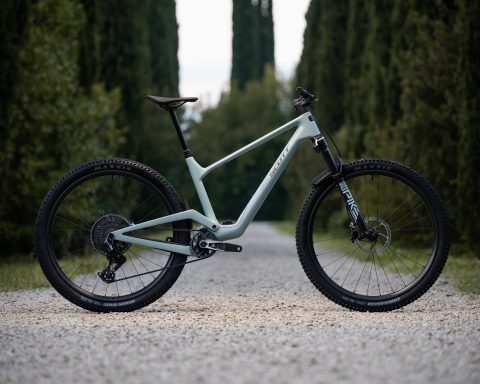
Then you have the Scale Gravel, based on a flat-bar MTB platform but with a rigid fork. Here you have all the tire clearance in the world and a geometry that truly gives you all the confidence and control you could wish for. While not the fastest bike in every scenario, it can definitely be the perfect tool for some of them.
But what happens if you try to mix these two styles into one bike, and also add a pinch of aero road bike DNA for good measure?
The result is the SCOTT Scale RC Aero concept.
A one-off custom build aiming to combine the riding position and efficiency of the Addict Gravel with the capability and rough terrain speed of the Scale Gravel. And to top it all off, aero elements straight from the road bike world.


Frameset
At the heart of this bike you’ll find a SCOTT Scale Gravel frame, but it doesn’t take more than a quick glance to notice that there is something very different about it. And in fact, the seat post and surrounding frame section actually comes from a SCOTT Foil RC road bike.
When starting this project, I asked SCOTT if they perhaps had some crash damaged Foil RC frame laying around. And while it’s usually never lucky with crashes and damaged bikes, in this case it was for me as they were able to provide me with one.
The next step was to cut up the brand new Scale frame, removing a big chunk of the upper seat tube area, to fit the Foil RC frame section. Not something you do every day and I definitely kept my fingers crossed during the process, hoping my idea would prove to be sound. But as a wise man once said: ”60% of the time it works every time”.
When I had a snug and straight fit, I brought it to my carbon repair expert who bonded everything in giving the original Foil part a P-shaped form, I also added a piece of carbon tube at the very front of this new construction to give it all a nice wedge-shaped aero form.
While we were at it, the drive side chainstay was also heavily modified to allow for bigger chainring clearance. With the Scale Gravel not exactly being a high-speed race focused bike, the chainring size is somewhat limited. But after this procedure we managed to create clearance for up to 46T chainrings.
After all of this raw carbon work, I spent a lot of time sanding and shaping to create a close to perfect surface finish. This to ensure I would have a nice and smooth base when starting the paint process.
The SCOTT fork was kept fairly standard with only the three rivets normally found on each side, to attach bags or other equipment, being removed. On this bike with its aero focus they wouldn’t be used anyway, and also it simply made for a super clean looking fork.


Components
The seatpost is the Syncros Duncan SL Aero CFT, which originally was developed for the SCOTT Foil RC. With that being one of the most aerodynamic road bikes out there, it was a perfect source for borrowing some aero tech.
Of course it is questionable how much real world difference it makes when you’re running 2.25” wide MTB tires, but marginal gains are still gains and if nothing else it has a huge impact visually on this bike.
Normally, aero seat posts can take away some comfort due to the inherent stiffness that comes with the D-shaped design. With the Syncros CFT version it’s quite the opposite, actually allowing for extra flex and comfort. The very narrow front section can flex at the top, while the second wider seat post piece provides stability and gives it a deep aero shape.
But perhaps best of all is that this design makes it possible to have a perfectly integrated rear light, the Syncros Campbell 20 Aero iL, adding a bit of Formula 1 vibe to the whole thing.
The Berk Lupina Monocoque saddle goes perfectly with the seatpost, further enhancing both comfort and the futuristic aero looks. As the name suggests, it’s made as a single piece of carbon fiber and it weighs just 99g.
Up front there’s a Darimo Nexum Drag Gravel cockpit in 80x380mm and -12 degrees stem angle. This size was actually specifically developed for two of my MTB/Gravel projects, as the longer frame reach (compared to a traditional gravel bike) requires a shorter stem.
But not only that, it’s easy to forget that with the slacker head angle you can’t run a normal -6 degrees aero cockpit unless you want it to look like a wing that automatically will start lifting the front wheel if you go fast enough. So in order to have a nice flat angle on the handlebars aero shape, the -12 degree stem section was needed.
The headset wedge, cover and spacers has also been custom made to ensure that the handlebar nicely integrates with the frame and at the same time allowing for the front-end internal cable routing.
At 183cm (6ft) I normally ride size Large, but here I sized down to Medium to shorten the reach and compensate for the drop-bar setup. All in all, on this bike I have almost exactly the same riding position as on my size Large SCOTT Addict Gravel.
The handlebar is wrapped with Syncros RC Bar Tape which is 3mm thick and offers superb grip, making it a genuine favorite of mine. On a normal gravel bike I might have opted for their 4mm thick
gravel specific version, but with the huge tire volume found here I expect to easily get away with running the 3mm. The front tire will simply take away so much vibration and small bumps.

Brakes
It was a no-brainer to go for the SRAM RED E1 brake levers, as they help deliver great stopping power but also fantastic ergonomics. And I truly appreciate the Bonus Buttons which can be used to control my Hammerhead Karoo computer.
Normally these of course come with matching flat mount brake calipers, but this frameset features a post mount interface. While it would’ve been possible to make it work by going up to 180mm rotors and conversion brake adaptors, like I do on my other similar builds, here I wanted to go all in with the aero theme.
So instead I chose to equip the bike with the 2-piston 612 Parts brake calipers. While the brand is based in Switzerland, these are machined in Germany and offer a truly unique stealth design.
The Carbon-Ti X-Rotor Aero are made in Italy and while falling in the marginal gains category when it comes to aerodynamics, they sure do a lot for the looks. But most importantly, they offer really good performance. The basic idea for their use of a carbon fiber carrier is that proportionally it puts more mass in the brake ring surface, compared to a traditional steel or aluminium design, keeping the overall weight to a minimum while still being able to handle heat dissipation well.

Drivetrain
The base of the drivetrain is the well proven SRAM RED XPLR rear derailleur and 13-speed 10-46T cassette, along with a SRAM RED chain.
The rear derailleur itself has been upgraded with a CeramicSpeed OSPW X ALPHA cage. Keeping drivetrain friction to a minimum, it’s a nice detail both visually and performance wise. The Alpha pulley wheels are super easy to clean as a nice little bonus, and features a special dust cover system that helps keep dust and debris away from the bearings for the best possible longevity.
Up front you’ll find a super interesting titanium crankset from WERT Cycling called StW-M. The crank arms are drilled almost all the way through, making them essentially hollow and pushing the weight down to an incredible 314g for the version pictured here.
On this bike I’m using a special pre-production crankset with a slightly wider than normal axle, allowing me to run a 6,5mm offset SRAM RED Aero power meter chainring in 44T (normally MTB frames require 3mm offset) while the Q-factor still remains narrow and aero.
It spins on the new CeramicSpeed BB ALPHA bottom bracket, which offers new levels of durability thanks to updated seal designs and other improvements while still keeping friction low as ever.
The pedals are the Xpedo M-Force 8 Ti.


Wheels
The prototype aero wheels are another highlight unique to this bike. The idea is similar to that of Zipp 303 XPLR SW, super wide rims improving aerodynamics and tire volume, but in a bigger version for MTB style tires.
The rims feature 45mm internal width, 52mm external width and a 70mm deep wave shaped profile. These proportions were chosen to go with 2.25” tires, of course to create better aerodynamics but also for the ride characteristics. The wide design gives a higher volume allowing for lower air pressures, but it also makes the tires more stable in many scenarios. Usually when going low in pressure, you risk the tires starting to ”fold” over the rim when for example pushing hard in corners, sprints or other high force input scenarios. But this wide stance allows for more stability and better predictability.
The reason for wanting to be able to run low pressure is of course that not only does it improve riding comfort but it also generally makes the bike faster on rough surfaces, with less deflection and lower rolling resistance as a result. You have to remember that this bike is not meant to be faster than a normal gravel bike with 45mm tires on smooth gravel, but to bring similar levels of speed and performance when the surface is rough and a regular gravel bike starts to struggle.
Not having special tires specifically developed for this super wide design was initially a bit of a concern, such as the overall profile becoming too square with the shoulder knobs not ending up in a good position for cornering grip. But interestingly enough, I realized that it’s extremely rare to find yourself in such extreme lean angles when riding gravel. On a road bike you have enough grip to lean over very far, but on gravel you wash out long before that so in reality a very round tire profile is not necessary.
The prototype rims were developed together with Faction Bike Studio and LX Lab, both based in Canada. Faction Bike Studio is a design and engineering firm normally doing work for other bike and component brands, with LX Lab offering carbon prototyping along with many other services.
The tires are Maxxis Aspen ST MaxxSpeed Team Spec in 2.25” width, and the only reason that the logos have been blacked out is that I wanted perfectly clean looks to go with the minimalistic and futuristic overall design of the bike.
While they can be set up tubeless, I usually run superlight REVOLOOP REVO.ULTRA MTB which are extremely light TPU tubes.
As the rims are prototype only and with no production plans, there was no focus on weight at this point and they came in quite heavy to say the least. But to help offset some of that, they were built up with Alpina Hyperlite aero spokes and Extralite HyperSmart 3 hubs which are among the lightest hubs in the world.
But it wasn’t just the weight that was a deciding factor for going with the Extralite hubs, they also have some quite unique features. Thanks to a Boost Adapter Kit they can be converted between 100/142mm gravel bike hub spacing and Boost mountain bike hub spacing. So this means I could use these wheels for testing on other bikes too if necessary, and also these hubs are available with a XDR freehub which is required to fit the 13-speed SRAM RED XPLR cassette.







Direi analogia calzante